China Top 10 Motorcycle Ebike Manufacturers?
China’s Motorcycle Ebike sector has moved beyond basic commuter models. Factories now combine motorcycle frames, hub or mid-drive motors, smart dashboards, and removable battery systems. This guide introduces ten Chinese manufacturers worth examining for distributors, fleet buyers, and everyday riders.
The ranking is not absolute. Production scale changes quickly. A smaller factory may offer stronger customization than a famous export brand. Therefore, this overview considers engineering capability, battery quality, motor performance, factory experience, export support, warranty terms, and after-sales service. We also examine whether companies publish meaningful specifications, rather than attractive but incomplete marketing figures.
Erik Buell, founder of Buell Motorcycle Company, once said, “The motorcycle is an emotional machine, not merely transportation.” That idea remains useful here. A Motorcycle Ebike should feel stable through a corner, predictable under braking, and comfortable after an hour of riding. Numbers alone cannot prove that. A 72-volt battery may look impressive, yet thermal control and cell consistency matter more during repeated acceleration.
Real details reveal more. Check frame welds, connector sealing, brake brands, tire load ratings, and charger protection. Ask for independent test reports. Request sample units before placing large orders. Some suppliers still overstate range, especially in cold weather or heavy traffic. That weakness deserves honest attention. This guide aims to provide practical comparisons, while recognizing that factory data may be incomplete and model specifications can change.
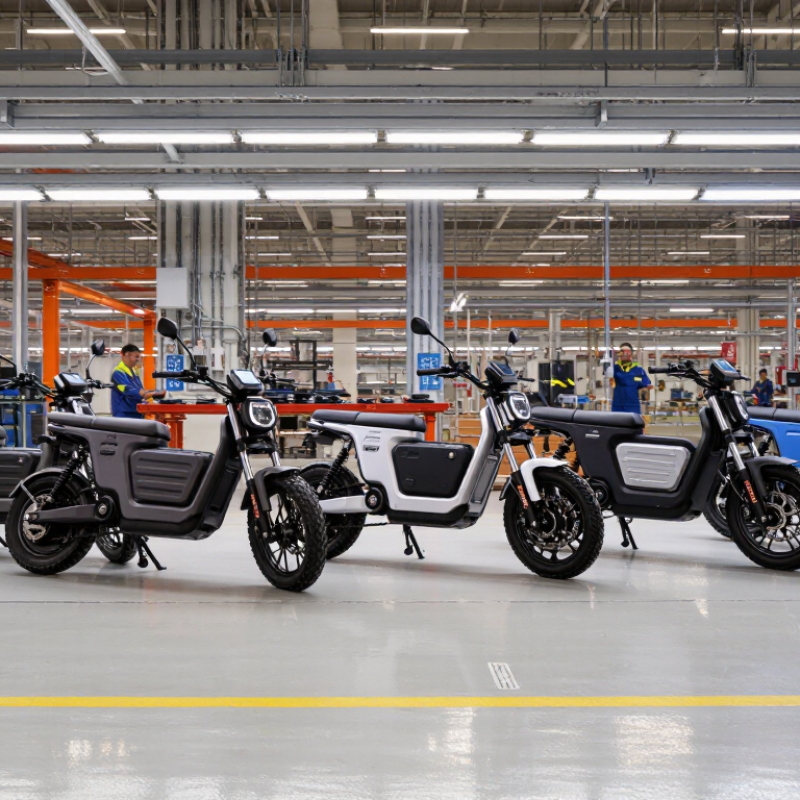
## What Defines a Leading Motorcycle Ebike Manufacturer in China
What Defines a Leading Motorcycle Ebike Manufacturer in China
A leading motorcycle ebike manufacturer begins with verified engineering, not attractive specifications. The China Bicycle Association reported more than 42 million electric bicycles produced in 2023. This scale creates useful manufacturing experience, but it also exposes weak quality control quickly. Serious suppliers should show battery test records, motor durability data, waterproofing results, and traceable production procedures. Their factories should explain how they manage welding, wiring, braking systems, and final inspection. Details matter.
Safety comes first.
The IEA’s Global EV Outlook 2024 identifies China as the dominant market for electric two- and three-wheelers. That position gives Chinese manufacturers strong experience with urban traffic, dense delivery work, and daily charging habits. However, production volume alone does not prove reliability. A credible manufacturer should provide transparent warranty terms, spare-parts planning, software updates, and independent certification records. It should also adapt battery capacity, suspension, tires, and lighting to the buyer’s climate and road conditions. Some product claims remain too optimistic, especially around range. Real-world testing is still essential. A better evaluation compares loaded riding, cold-weather performance, charging time, and braking distance instead of trusting catalogue numbers. Companies that openly report failures may deserve more confidence than those presenting perfect results.
## How China’s Motorcycle Ebike Industry Has Developed
China’s motorcycle ebike industry has changed from small workshop production into a structured manufacturing sector. Early models often used basic steel frames, modest batteries, and simple mechanical brakes. They served short urban trips. Today, factories commonly use automated welding, digital testing, and standardized assembly lines. Production feels faster, but speed does not always mean better quality.
Battery technology has improved the riding experience. Larger capacity packs support longer commutes, while improved controllers provide smoother acceleration. Many manufacturers now test waterproofing, braking distance, charging cycles, and frame strength before shipment. These checks build trust with distributors and daily riders. However, testing methods can differ between factories. A published specification may not reflect real traffic, weather, or rider weight.
The leading manufacturers are increasingly judged by engineering consistency, after-sales support, and parts availability. A quiet motor, firm suspension, and clear instrument display matter during ordinary use. So does a replacement brake lever arriving quickly. Manufacturing clusters also benefit from nearby suppliers, which can reduce delays and improve design revisions. Yet the industry still faces pressure from changing regulations, battery recycling needs, and uneven quality control. Some product claims remain too optimistic. Buyers and importers should inspect certifications, warranty terms, sample units, and production records before choosing among China’s top ten motorcycle ebike manufacturers.
Fancy features attract attention. Reliable maintenance earns it.
## Top 10 Chinese Motorcycle Ebike Manufacturers by Core Strengths
China’s motorcycle ebike sector includes manufacturers with very different strengths. The strongest ten are not identical in design, scale, or market focus. One specializes in high-volume commuter models, using automated welding and stable battery sourcing. Another focuses on lightweight urban frames, narrow tires, and simple dashboards. A third is known for rugged utility bikes, reinforced racks, sealed connectors, and stronger low-speed torque.
Core strengths become clearer during factory evaluation. One manufacturer offers mature export documentation and traceable quality records. Another provides flexible customization for lighting, displays, and cargo capacity. A battery-focused producer emphasizes cell matching, thermal monitoring, and replaceable packs. One performance-oriented team develops suspension systems for uneven roads. Another keeps maintenance practical, with common fasteners and accessible controllers.
The remaining manufacturers compete through cost control, rapid prototyping, regional assembly support, and after-sales training. These strengths matter more than attractive photographs. Inspect weld consistency. Measure braking distance. Check battery temperature after repeated climbs. Ask for aging-test data, not promises. I have found that a polished sample can hide weak cable routing or noisy bearings. That deserves attention. Independent inspection remains wise, because factory claims may vary by production batch. A reliable supplier should explain limitations openly, provide test records, and accept reasonable pre-shipment checks. Price alone is a poor ranking method.
## Key Products, Technologies, and Market Advantages of Each Manufacturer
China’s top ten motorcycle ebike manufacturers compete through focused engineering, not only production volume. The IEA Global EV Outlook 2024 reports more than 40 million electric two- and three-wheelers sold globally in 2023. Chinese factories remain central to this supply chain. Leading manufacturers typically offer hub motors from 1,500 to 5,000 watts, removable lithium batteries, and connected dashboards. Their key advantage is rapid customization for delivery fleets, urban commuters, and export markets.
Battery safety is becoming a stronger differentiator. Better suppliers use battery-management systems, temperature sensors, cell balancing, and water-resistant housings. Some provide lithium iron phosphate packs, which support longer cycle life and improved thermal stability. Others develop dual-battery layouts for extended range. The Ministry of Industry and Information Technology continues to emphasize standards, traceability, and intelligent manufacturing. However, claimed range can vary sharply with rider weight, hills, temperature, and speed. I would verify tested range before trusting catalog figures.
Tips: Compare motor torque, battery chemistry, warranty coverage, spare-part access, and charger certification. Ask for independent test records. A polished app means little if replacement parts arrive slowly. Also inspect welding, cable routing, brake performance, and battery locking hardware. These details often reveal the manufacturer’s real engineering discipline.
## How to Compare Chinese Motorcycle Ebike Manufacturers for Your Needs
How to Compare Chinese Motorcycle Ebike Manufacturers for Your Needs
China remains a major electric two-wheeler production center. The IEA’s Global EV Outlook 2024 reports that China dominates global electric two- and three-wheeler sales. The China Bicycle Association also reported more than 40 million electric bicycle units produced in 2023. These figures show scale, not automatic quality. Compare factories through audited output, export history, and documented quality controls.
Check the battery before comparing price. Request cell specifications, battery-management functions, cycle-test results, and transport documentation. UN 38.3 and IEC 62133-2 testing can reveal basic safety preparation. Ask whether range figures use controlled laboratory conditions. Real riders face hills, cold weather, heavy loads, and frequent stops. Marketing ranges often feel optimistic. I would reduce the claimed distance by 20 to 30 percent during early planning.
Inspect the motor, controller, frame welds, braking system, and spare-parts policy. A serious supplier should provide traceable serial numbers and failure-rate records. ISO 9001 certification helps, but it does not replace factory sampling. Confirm local approval requirements before placing an order, including lighting, speed limits, electromagnetic compatibility, and battery rules. The World Bank links reliable two-wheeler transport with affordable urban mobility, yet reliability depends heavily on maintenance access. A low purchase price can become expensive after one unavailable controller. Also compare warranty response time, technical manuals, packaging quality, and video evidence from endurance testing. Factory presentations can look perfect. They are not proof.


 Track Your Shipment
 Online Enquiry
 Sign In
 English

